 Uniswap
 liquidity pools can show apparent fee gaps as token balances and range status change
Uniswap liquidity pools can show a rising fee balance while the underlying position drifts away from the amounts originally deposited. Diagnose the mismatch by matching the exact pool, protocol version, fee setting, price range, and observation time, then compare principal quantities with collected and uncollected fees. Use one valuation time for both the position and the simple-hold benchmark.
A position view combines several states that do not move in lockstep. Pool swaps alter token composition, active liquidity determines fee eligibility, and interface data may lag the onchain record. Keeping those layers separate prevents a normal balance change from looking like missing funds.
Bottom line: Position status, token composition, and fee accounting help distinguish normal pool behavior from timing, ownership, or pool-selection problems behind a dashboard mismatch.
Position States Behind the Mismatch
Position status explains what the displayed amounts can mean. Start with the exact network, token contracts, pool, protocol version, and position identifier. A similarly named pair or another fee configuration can have different balances, volume, active liquidity, and earnings.
Active and Earning
An in-range v3 or v4 position supplies active liquidity at the current pool price. It can earn a proportional share of fees from swaps that use that exact pool. The share varies with the position's liquidity and the total liquidity active during each swap.
Out of Range
An out-of-range concentrated-liquidity position becomes single-sided rather than liquidated. It remains under the owner's control, yet it earns no swap fees until the pool price returns to its selected range. A current in-range label does not prove that the position stayed active throughout an earlier period.
Closed or Missing
A closed label means the provider removed the position's liquidity, so it no longer earns pool fees. The v3 or v4 position NFT may remain as a record. A missing position can instead reflect the wrong wallet, a transferred NFT, an indexing delay, or a different network selection.
Range Boundaries Set the Fee Window
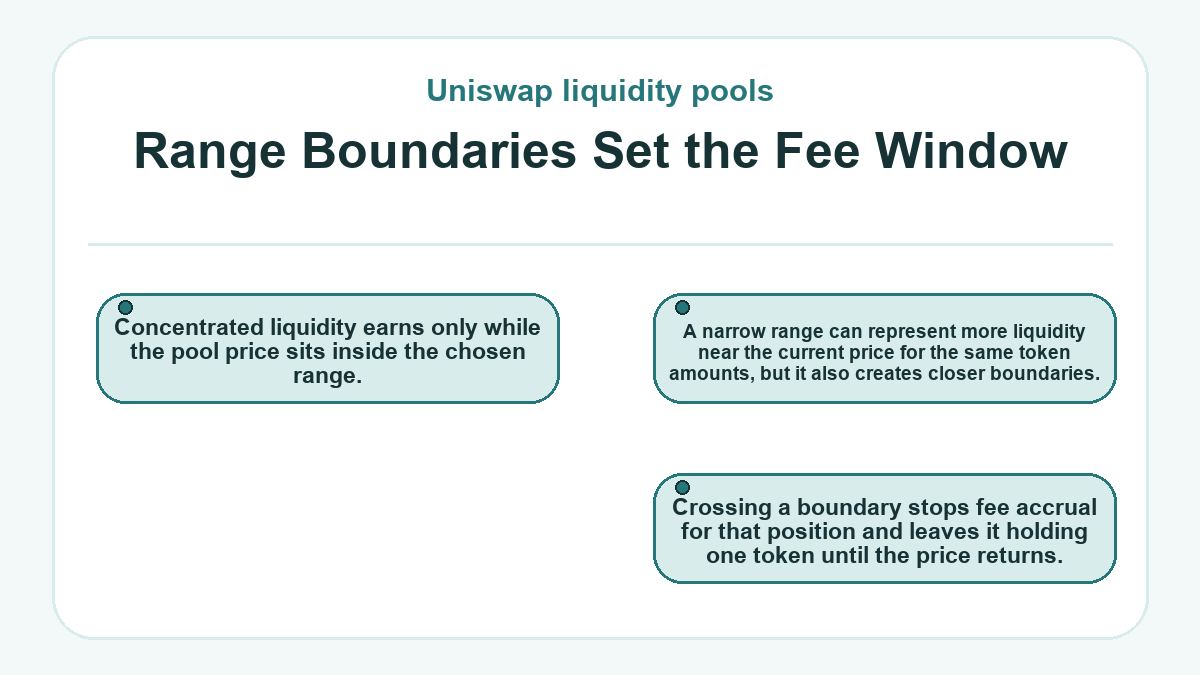
Concentrated liquidity earns only while the pool price sits inside the chosen range. A narrow range can represent more liquidity near the current price for the same token amounts, but it also creates closer boundaries. Crossing a boundary stops fee accrual for that position and leaves it holding one token until the price returns.
In Uniswap v3 and v4, earned fees accrue separately instead of being added automatically to a position's liquidity. Range limits do not follow the market automatically. Changing them requires removing liquidity from the existing range and creating a new position, which turns a diagnostic decision into one or more onchain transactions.
Swap Flow Explains the Token Mix
Every swap exchanges one pool token for the other. As swaps move the pool price, the token amounts represented by a liquidity position can change even without a deposit, withdrawal, or fee collection. That balance shift is part of automated market making and is not, by itself, evidence that tokens disappeared.
Uniswap v2 spreads liquidity across the full reserve curve. Concentrated positions in v3 and v4 participate only within their selected ranges. As price travels through a range, the position gradually converts between its two tokens. At either outer boundary, the position becomes entirely one-sided, with the resulting token determined by the price direction and token ordering.
Fee Accounting Changes by Protocol Version
Protocol version determines where fee growth appears. Applying one version's display logic to another can create a false shortfall.
Uniswap v2 Reserve Growth
Uniswap v2 swap fees enter the pool reserves. A provider's UNI-V2 tokens represent a proportional claim on those reserves, so earnings appear through growth in the value of that claim rather than a separate uncollected-fee counter. Valuation requires the LP token balance, total LP token supply, and reserves from the same block.
Concentrated Position Fee Balances
Uniswap v3 and v4 track fees owed to a position in the two pool tokens. Providers can collect those tokens without removing their liquidity. Collecting fees sends the owed tokens to the chosen recipient, so a lower uncollected-fee figure does not mean the earlier earnings vanished.
Uniswap v4 Pool Rules
A v4 pool can use a static or dynamic fee configuration, while hook logic may affect swaps, liquidity actions, and fee behavior. The applicable rules belong to that exact pool. A comparison must preserve its pool configuration across snapshots rather than borrowing assumptions from another v4 pool with the same token pair.
A Hold Benchmark Needs a Shared Snapshot
A hold comparison asks whether the liquidity strategy outperformed or trailed keeping the starting token quantities. Both sides must use identical token prices and the same valuation time.
The Liquidity Strategy Side
The strategy value combines the position's current principal token amounts, uncollected fees, and any collected fees included in the measurement period. Subtract relevant network costs and account for later deposits or withdrawals. Otherwise, a management transaction can look like investment performance even though it changed the capital being measured.
The Simple-Hold Side
The hold value uses the original quantities of both tokens at the same current prices. Comparing the current position with its original fiat value mixes price movement with pool rebalancing. The difference before fees isolates the balance-shift effect; adding fees and costs shows whether the full liquidity strategy closed that gap.
Missing Charts and Delayed Displays
Missing charts, fiat conversions, or price-range graphics can reflect unavailable indexed data rather than a change in the pool contract. Token quantities and transaction records may still exist onchain. A blank chart therefore cannot establish that fees are zero, the position is closed, or a balance change occurred at the time the display failed.
Record the position identifier, pool configuration, block or transaction time, token amounts, range limits, current pool price, and fee balances before drawing a conclusion. If an interface refresh later fills the gap, compare the same fields again. A changed fiat estimate alone does not prove that the underlying token quantities changed.
Read-Only Checks Precede Onchain Actions
Read-only checks should come before any wallet confirmation. Reopen the exact position, match its pool and version, review relevant transaction receipts, and allow indexing time after a recently confirmed transaction. These checks preserve the existing range and balances while isolating whether the mismatch comes from timing, accounting, ownership, or pool selection.
Collecting v3 or v4 fees sends the owed tokens to the chosen recipient without closing the position. Reranging requires removing liquidity and creating a new position, while a full removal ends fee participation until liquidity is added again. Each action has a network cost and changes the next snapshot, so it should follow the diagnosis rather than serve as a test.
Final Verification Before a Position Change
Use two snapshots with the same fields to decide whether the next valid step is to wait, collect, rerange, remove, or investigate further.
- Fix one comparison time or block for every token amount and valuation price.
- Match the network, protocol version, token contracts, pool, fee configuration, and position identifier.
- Record the range boundaries, current pool price, and in-range status.
- Separate principal, uncollected fees, collected fees, deposits, and withdrawals.
- Value the liquidity strategy and hold benchmark with the same token prices.
- Review transaction receipts and network costs before authorizing a position change.
If these records still conflict, stop before the wallet confirmation. A blank chart, a changed fiat conversion, or a current status label cannot reconstruct an earlier fee interval. Historical transactions and like-for-like snapshots set the practical limit of what the visible position state can prove.
Helpful answers about Uniswap liquidity pools
Can a Transferred Liquidity NFT Explain a Missing Position?
A transferred liquidity NFT can explain why a v3 or v4 position disappears from the original wallet view. The NFT owner or an approved operator can manage the position's liquidity and collect its fees. If ownership moved to another address, the position can remain open while the first wallet shows nothing. Check the transfer record and current owner before classifying the position as deleted or closed.
Is an LP Token Balance Enough to Reconstruct a Uniswap v2 Position?
An LP token balance is not enough to reconstruct a Uniswap v2 position. The calculation also needs the pool reserves and total LP token supply at the same block. Fees remain in v2 reserves rather than appearing as a separate uncollected balance. A wallet balance alone cannot distinguish reserve growth, later deposits, withdrawals, or changes in the holder's proportional share.
Does Collecting Fees Require Removing a concentrated-liquidity Position?
Collecting fees does not require removing a Uniswap v3 or v4 position. Collection sends the owed tokens to the chosen recipient and reduces the displayed uncollected amount, so the transaction must remain in the performance record. Uniswap v2 handles fees differently because swap fees stay in pool reserves and contribute to the value represented by the provider's LP tokens.
Are Uncollected Fees Used When Adding to an Existing v4 Position?
Uncollected fees can be used as part of an add-liquidity transaction for an existing v4 position. The wallet may spend less than the gross token amounts added, while the uncollected fee balance falls. Reconcile both effects within the same transaction before treating the lower fee balance as missing income or attributing the full increase to a new wallet deposit.