 Uniswap
 Lets You Prepare a First Swap, Confirm the Outcome, or Stop
Uniswap turns a selected network, token pair, amount, route, and execution limits into a wallet request that can still be rejected. Before authorizing anything, compare the token identifiers, quoted output, minimum received, price impact, fees, and network cost with your plan. Stop if any field conflicts with that plan. After submission, confirm the actual outcome through the transaction record and balance changes, not the earlier quote or an approval alone.
In short: A first swap is ready only when the network, token identifiers, amount, minimum output, and every wallet request are consistent with the intended trade.
Inputs That Must Agree Before Signing
A first swap needs a connected wallet on the intended network, the correct input and output tokens, enough spendable balance, and a viable route. The selected network matters because balances and token identifiers are network-specific. Matching names or symbols do not establish that two tokens are the same asset.
The amount entered also affects the proposed route, price impact, minimum output, and estimated network cost. If the input is the asset used to pay network charges, swapping its entire balance may leave nothing available for execution. A smaller input can preserve the amount needed to submit the transaction.
Authorization is a separate dependency. A token may require an onchain approval, a message signature, or both before the swap request appears. An approval permits a specified spender to use tokens within its scope. It does not prove that a swap occurred, and it should not be mistaken for the final transaction.
What the Quote Can and Cannot Promise
A swap quote describes a proposed exchange under the liquidity and network conditions available when it was calculated. Routing can use one or several liquidity sources, while some swaps execute through a signed order filled by another party. The quote does not reserve those conditions while the reader reviews the request.
Quoted output and minimum received answer different questions. Quoted output is the estimate for the proposed route. Minimum received is the lower execution boundary associated with the permitted slippage or order terms. If execution cannot satisfy that boundary, the swap should fail or remain unfilled rather than complete below it.
Price impact comes from the swap's effect on available liquidity, while slippage covers movement between quoting and execution. Network cost is separate from both. Increasing maximum slippage can make a changing market easier to execute, but it also permits a worse output. It does not repair a wrong network, incorrect token address, missing allowance, or incompatible token behavior.
From Review Screen to Receipt
The submission path begins with a final review of the input, output, amount, minimum received, route, and cost. When spending authorization is required, the wallet may present an approval transaction or Permit2 signature before the final swap request. Each request should be read on its own because the requests have different effects.
An onchain approval can create an allowance and consume a network fee without exchanging the selected tokens. A Permit2 signature can authorize token spending without being an onchain transaction itself. A signed swap order can authorize the exchange and be filled by another party, while a direct onchain route uses a swap transaction.
After submission, the interface may show a pending state while the network processes the request. A transaction hash connects that attempt to its onchain record. The completed record should show a successful status and token transfers that agree with the wallet's balance changes. A success message without matching onchain evidence is not enough to reconcile the swap.
Where Can I Stop Without Committing a Swap?
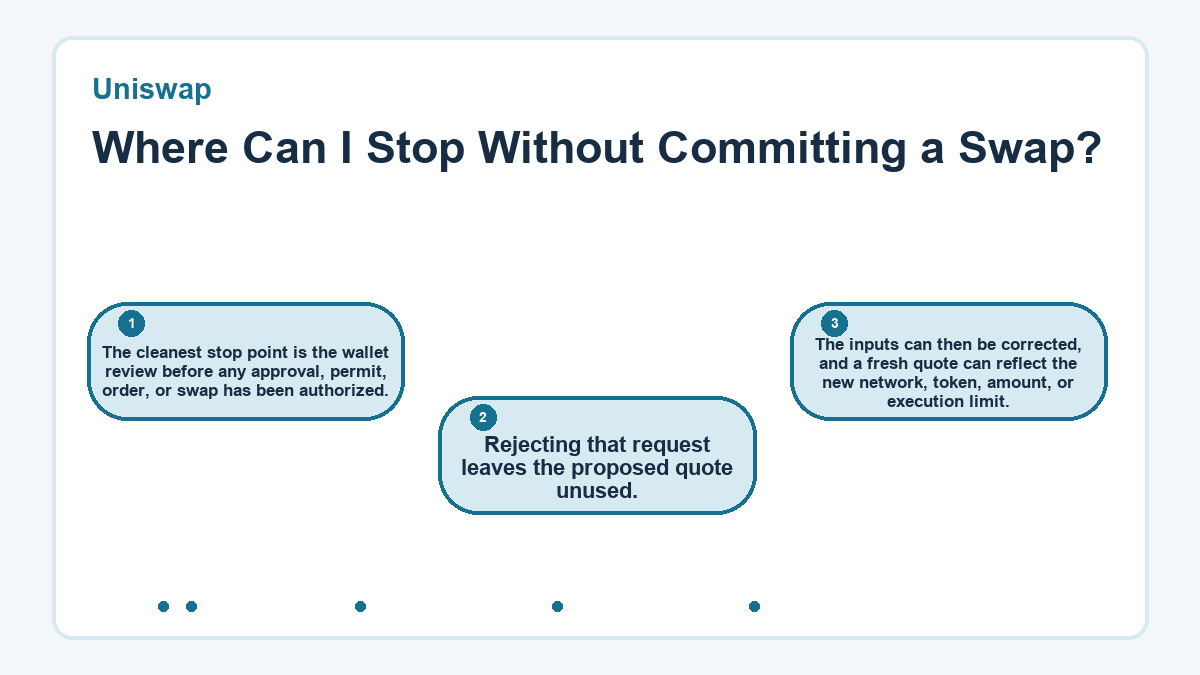
The cleanest stop point is the wallet review before any approval, permit, order, or swap has been authorized. Rejecting that request leaves the proposed quote unused. The inputs can then be corrected, and a fresh quote can reflect the new network, token, amount, or execution limit.
Once an approval transaction is broadcast, the process has already created a separate onchain action. A mined approval may leave an allowance even if no swap follows, and removing it requires another onchain transaction. A signed message can also grant meaningful authority, despite having no network fee at the moment of signing.
A submitted swap is no longer freely reversible. A pending transaction may support replacement or cancellation through the wallet, but cancellation is not guaranteed because the original can confirm first. After confirmation, the swap itself cannot be undone through the interface. Any later exchange is a new transaction under new conditions.
A Network Mismatch Before Signing
A network mismatch is visible when the network named in the wallet request differs from the intended network. Unexpected token identifiers or balances can provide further evidence of the mismatch. The swap should remain unsubmitted. Rejecting the request preserves the reversible state and avoids turning a configuration error into an approval or transaction.
After the wallet moves to the intended network, verify or reselect both tokens using their correct identifiers on that network. The revised request needs a fresh quote because available balances, liquidity routes, minimum output, and network costs can differ. The original and revised reviews can then be compared field by field.
| Parameter | Value to Record | Effect on the Swap | Stop or Recovery |
|---|---|---|---|
| Network | The network selected in both the interface and wallet | Determines balances, token identifiers, contracts, and the fee asset | Reject the request, align the network, and obtain a fresh quote |
| Input Token | The intended token identifier on the selected network | Identifies the asset that the transaction may debit | Discard the quote if the identifier differs from the starting record |
| Output Token | The intended receiving-token identifier on that network | Identifies the asset expected after successful execution | Reselect the token before granting permission or signing |
| Sell Amount | The exact amount entered for the proposed swap | Changes the route, price impact, output, and required allowance | Edit the amount and request another quote |
| Output Boundary | The quoted output and minimum received shown for the route | Separates the estimate from the lowest permitted execution outcome | Stop if the boundary does not meet the intended outcome |
| Authorization | The spender, allowance, permit, or signed-order scope shown by the wallet | Controls what authority is granted before execution | Reject an unexpected request; revoke a mined allowance separately if needed |
| Network Cost | The wallet estimate and available balance of the required fee asset | Determines whether an onchain request can be processed | Preserve enough fee balance, change the input, or wait before retrying |
| Proceed only when the revised values describe one consistent network, token pair, amount, authorization, and acceptable output boundary. | |||
The corrected request may produce a different output even when the intended pair and sell amount stay unchanged. That difference shows that the quote changed with the revised inputs or market conditions. It is a reason to review the new terms, not a reason to reuse the discarded request.
Reading Success, Failure, and a Clean Retry
A transaction record distinguishes a completed swap from an approval, pending attempt, or failure. Successful status should be reconciled with the debited input balance, credited output balance, and the token identifiers involved. A wallet may hide an unfamiliar token, so a missing display entry does not override a successful record on the correct network.
An onchain transaction can consume a network fee even when execution fails. The intended token exchange should revert in that case, but an earlier approval can remain active because it was a separate action. Compare the failed receipt and allowance state with the original record before deciding what needs correction.
A pending attempt needs its network status checked before another swap is submitted. Repeated attempts can create several pending transactions or allow more than one valid request to execute. If the wallet offers cancellation, confirm the cancellation record before treating the original attempt as closed.
A clean retry begins only after the cause has been identified and corrected. That may mean restoring enough fee balance, refreshing an expired quote, lowering the sell amount, correcting the network, selecting the intended token identifier, or repairing an approval. Raising slippage is appropriate only when the execution boundary caused the failure and the wider range remains acceptable.
When no transaction was broadcast, there is no onchain swap record to reconcile. When a transaction failed, retain its hash and request a new quote after correcting the dependency. When it succeeded, the receiving balance and transaction record provide the completion evidence for the first swap.
Uniswap: common questions
Do I Need the network's Native Token for a First Uniswap Swap?
Direct onchain swaps require the network's native asset to pay network costs. On UniswapX, a filler generally pays the swap's network costs, so the swapper may not need the native asset for that step. Initial onchain approvals and wrapping a native asset for UniswapX still require network costs. Keep enough outside the sell amount when the wallet shows that you must pay those costs.
Can a Token Approval Complete Even If the Swap Does Not?
A token approval can complete without any swap taking place. Approval is a separate authorization that may be recorded onchain before the exchange is submitted. If the activity record shows only an approval, check the allowance and return to a fresh swap quote. An onchain allowance can remain available to the approved spender until it is spent or revoked. A time-limited signature approval can expire.
When Should I Request a New Quote After Changing an Input?
Request a new quote whenever the network, token identifier, amount, slippage setting, or authorization state changes. The earlier quote described the previous inputs and market state. If another attempt is pending, check its transaction status before submitting the replacement. A fresh quote does not cancel a transaction or signed order that has already been sent.
Is a Token Symbol Enough to Confirm the Asset Before Signing?
A token symbol is not enough to confirm the asset. Display names and symbols can be copied, while the token identifier on the selected network determines which asset the swap will use. Compare that identifier with the intended token before relying on the quote, approval request, or wallet balance label.
Does Raising Maximum Slippage Solve Every Failed First Swap?
Raising maximum slippage solves only failures caused by the permitted output range being too narrow for execution. It cannot correct the wrong network, a copied token identifier, insufficient fee balance, an expired quote, a missing allowance, or unsupported token behavior. A wider setting also accepts a lower minimum output, so compare that boundary with the intended result before retrying.
Can a Failed Onchain Swap Still Reduce the native-token Balance?
A failed onchain swap can reduce the native-token balance because the network may charge for processing the transaction even when the token exchange reverts. A separate approval sent earlier may have its own cost and can remain active. Check the failed receipt, current balances, and allowance state instead of assuming that every part of the wallet returned to its exact starting condition.